There are many structures at Camp High Rocks that bring back fond memories of our time while we were once campers or staff. For most of the boys, their cabins are some of the most lasting memories of their experience. The CT Bridge is a small, unremarkable structure that few think about even while they walk over it. Even some of you who have come to High Rocks may not know its name. It’s just there. Why wouldn’t it be there? Today’s blog is how it came and continues to be a part of a long High Rocks tradition.
There are many structures at Camp High Rocks that bring back fond memories of our time while we were once campers or staff. For most of the boys, their cabins are some of the most lasting memories of their experience. The CT Bridge is a small unremarkable structure that few think about even while they walk over it. Even some of you that have come to High Rocks may not know its name. It’s just there. Why wouldn’t it be there? Today’s blog is how it came and continues to be a part of a long High Rocks tradition.
The CT bridge began back in the summer of 1967. This was a time when High Rocks was owned and operated by Jane and Sumner Williams, each running their own 5-week session, five weeks of boys and then five weeks of girls. Power tools were limited and even those available only ran off of electricity. The building resources were stronger, but harder to come by and camp was A LOT more rustic and remote.
I am going to step away from these next two paragraphs and let you read from the prose of Bill Parsons, who was a camper from 1963 to 68, and then on staff in 1971 and 72. He was on the original build of the first version of the CT bridge. I asked Bill to write up what he could remember about the building of the CT Bridge. If you don’t know Bill, he’s a lifelong low country boy from Louisiana. So try to listen for the New Orleans draw with a little bit of rasp and reminiscence that comes with lifetime on the police force and fond memories of when he got to go to the mountains of Western North Carolina at a place called High Rocks.
“Step 1.0 was begun in the summer of ’67. It was constructed entirely by hand (no power tools) out of locust logs and lumber that was 2×6 or 8 that was impregnated with heavy creosote. We set the pilings using a posthole digger or shovel and a sledgehammer. We’d set two posts, nail a crosspiece on then set two more posts further out. The lumber was a true dimension, cut with a hand saw, and hard as a rock (so were the locust pilings). We sed heavy spikes and bent a good number of them. At one point a hammer got dropped down into the mud, and to find it, another gentleman decided to drop his hammer to find the first one. To this day there are still two hammers down there. We used a 3x4x5 piece of plywood as a square because it floated. The western side was straight as an arrow, the other side, not so much. Due to trips, hikes and other ‘duties’ of us campers only the frame was built that summer. The creosote got all over us. All of us were upper-seniors and names that come to mind (I’m sure there are lot more involved) are: David Romero, Bobby Reagan, Bubba Haynes, Joel Adams, David Shenk, David Chalmers, David McCaullie, Bob Stoors, William Bain, Gilly Daniels, David Shenk, Corky (Hammel?), and Pete Hilzim.”
“Step 1.1 was done in the summer of ’68. Mr. Will ordered the deck lumber that winter and it was ready for us that year. Thank goodness he grabbed me one lunch (rest hour) time and gave me a circular saw to cut many 4′ pieces which all of us loaded into the trailer behind the jeep and took to the job site. Dee (caretaker) was there and helped us reset some pilings to straighten out the eastern side. We all then grabbed a hammer and (after more nail bending) completed the deck. To celebrate the occasion, one Sunday the whole camp took out bag lunches, walked across, and then ate in the clearing on the point across the new bridge. Also. Bubba Haynes cooked up a huge batch of sassafras tea in the kitchen as Lee(cook) was off for the day. Some of us hauled this (very hot) heavy pot to the canoe dock to paddle it across the lake. Bubba was sitting on the lid, which suddenly collapsed, Bubba’s butt sank into the hot tea, and he shot out of the canoe into the water like a cannon. The result was some 2nd degree blisters on both cheeks. Mrs. Wheeler was really amused with that one. The sassafras tea was a big hit instead of bug juice despite Bubba’s baptism of fire.”
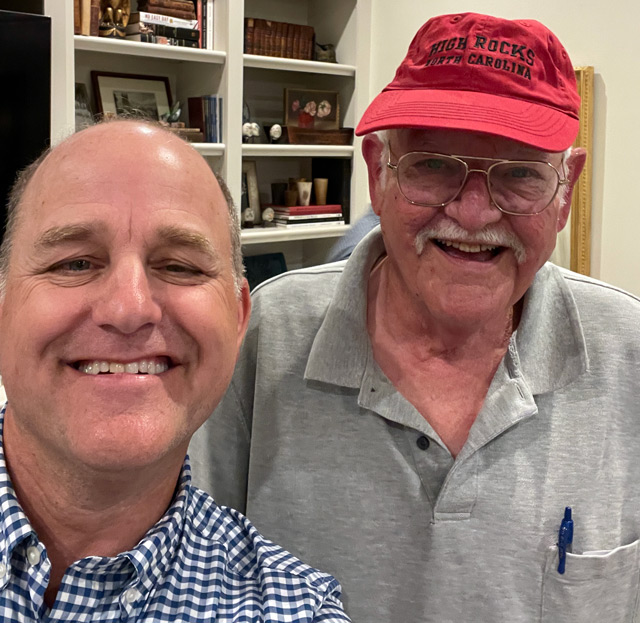
Here is a recent picture of Bill Parsons. He and Don met up at a New Orleans camp gathering to talk the history of the first CT Bridge .
What a great story! As a testament to this project, the next generation decided to add a more structured event for similarly aged boys. Hank and Townsend Birdsong took over the camp in 1988. Townsend (the youngest of Jane and Sumner’s five children) along with her husband Hank decided to create what they would call The CT Project.” In the early 2000’s our CT groups were often assigned something to complete, build, or design for the whole of camp. It was part of their “graduation” from many years as campers and now staff-ish existence. The “CT Bridge” was on the docket for 2008. Back then, CTs only attended the Four Week session. Hank Birdsong spearheaded the operation and plan for the guys. He even reached out to Bill Parsons (who was still a frequent visitor) to see if he could come up to help. Bill was more than excited. He even led a small group of campers in a “pirogue” boat-building project during that same session. Being from Louisiana, Bill had a lot of experience in this craft of building this style of shallow boat out of a single sheet of marine plywood.
Like the first iteration of the bridge, the process took some time. If you know Hank, then you know how he can get “laser focused” on a project to the point where not even his wife could get in his way. Anyhow, Hank put his head down and worked at it like a downhill skier, making his decisions along the way by the seat of his pants, as he flies down the hill, but nothing was going to stop him.
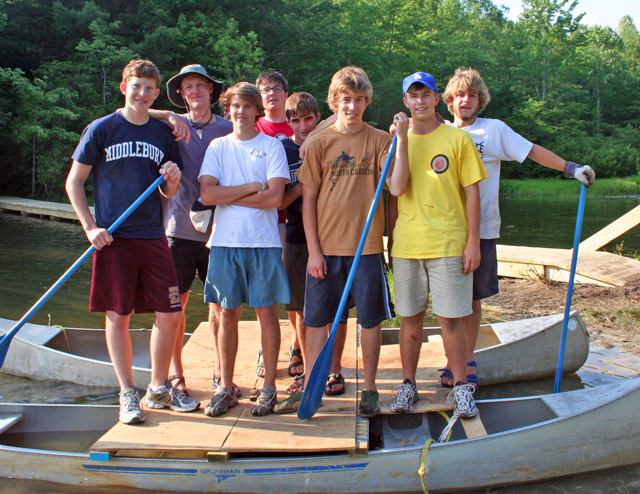
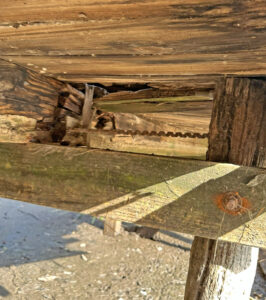
Once Bill arrived and the boys were versed on the process, the CT Bridge 2.0 was underway. They hit the ground with demolition and assessment. As you may see from the pictures, the guys crafted a “barge” out of some plywood and two canoes. This served as their main working platform once the decking was removed. Many of the old locust posts were still in good shape. It was said that the team replaced four posts and added a set of two to shore it up a bit. Of course, camp continued through the whole time, so many days left camp empty of CT workers. On those days, not much happened. It still took most of the session to complete the project. The boys did have the advantage of battery-operated tools. In one such event with power tools, the boys were using an auger bit to drill holes for carriage bolts that would attach the stringers. While they were adding a hole to one of the locust posts, the bit got stuck. After many tries, it was not coming out without damaging it. The team decided to leave it there. More on this history in version 3.0.
2.0 has a lot of pictures to help us remember the event and spot the staff and campers. The team consisted of Adult Leaders: Hank Birdsong, Mike Neumann (CT counselor), and Bill Parsons. The 2008 CT class: Benjamin Birdsong, Stewart Boss, Gardner Davis, Scott Richardson, Carl Holland, Fitz-Henry Boze, and Finn Althoff. My favorite picture still shows a bit of a bend in the structure. Bill mentions this in his iteration of their build, if you look above.
The boys had to craft a “barge” during the CT Bridge 2.0 project to allow for work alongside the bridge.
The barge, also many iterations, is still around. It is getting a facelift this year as well with new decking.
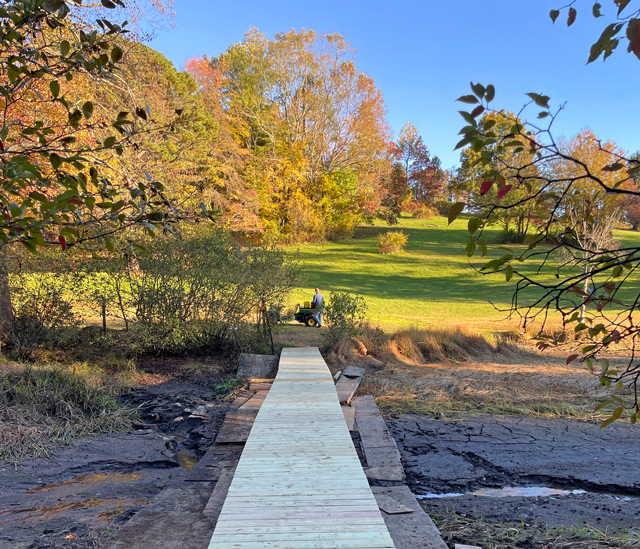
So why are we writing this now? Well, it was time for CT Bridge 3.0. After many years of service, a few repairs, and some really bad pressure-treated wood, it was time to redo the bridge. We made plans for almost five years, with each year passing and the event getting triaged out of the schedule, before we finally got to the project. Hurricane Helene left us with some bank work and a repair of our beloved rope swing that were both damaged near the camp house. We had to lower the lake for that project, which led us to a perfect opportunity for the CT Bridge. And so it began… CT Bridge 3.0. This time it was a little less storied, since we had professionals on hand. The team consisted of Nathan Noland, Nico Viveros, and Jeff Nichols. The boys had all the skills and tools they needed. Once the lake was down, they removed the decking that had been fortified with some plywood in the last couple of years for safety. These pieces created perfect “scaffolding” that they could lay in the mud alongside the structure to allow for perfect working platforms. Without the lake being in the way and the skilled craftsman involved, the boys had this done in no time. As with 2.0, the guys had to replace some of the posts. Surprisingly, many of the locust posts still remain. There were only a few 4×4 treated posts added to the base. All new stringers and decking were added to the posts to make a new CT Bridge. Remember the auger bit? Well, the boys laughed out loud when they saw it sticking out of a locust post during the demolition. Still there for nearly 20 years. As a token to those who had come before them, the boys left the auger bit sticking out of the post.
Here is the completed version of the CT Bridge 3.0. It even has a little swagger like its predecessors. The Legend Lives On…
I hope the legend continues. Each generation has put their part into making this structure a near memorial of those who had come before them. They say we are all versions of those who come and go from our lives. I like to think that each camper generation has a small piece of those who put their time and talents into this historical marker. I hope I am around to hear about CT Bridge 4.0. One thing is for sure: there will be stories.
If you’re a camp alumnus, don’t forget to update your contact information if you have a new email or if you haven’t heard from us in a while. We may not have your updated info!

High Rocks is an authorized Special Use Permit Holder by the Pisgah, Nantahala, and Sumter National Forests. • Privacy • Site Map • Camp High Rocks © 2026